
The United Arab Emirates is making a major advance in its tax and financial system by moving from traditional paper and static PDF invoices to a fully integrated electronic system known as the UAE Electronic Invoicing System. For any business based in the UAE, e-invoicing is no longer something that can be treated as a ‘future project’, it has become an immediate requirement in terms of compliance.
The following information will tell you how the system functions, the important legal deadlines, which businesses are impacted, and provide you with a step-by-step plan to ensure your organization is fully ready.
What Is UAE e-Invoicing?
At its heart, UAE e-invoicing involves the automatic generation, exchange, and submission of transaction data in a standard, machine readable digital format. Within the framework set up by the Ministry of Finance (MoF) and the Federal Tax Authority (FTA), an e-invoice is more than just a digital document; it is XML data arranged in accordance with the international Peppol PINT-AE specification.
Important point: A PDF sent by email, a Word document, a scanned receipt, or a JPG image does not constitute an e-invoice according to UAE law. Compliance is not achieved if the system cannot process the data automatically without having to involve a human.
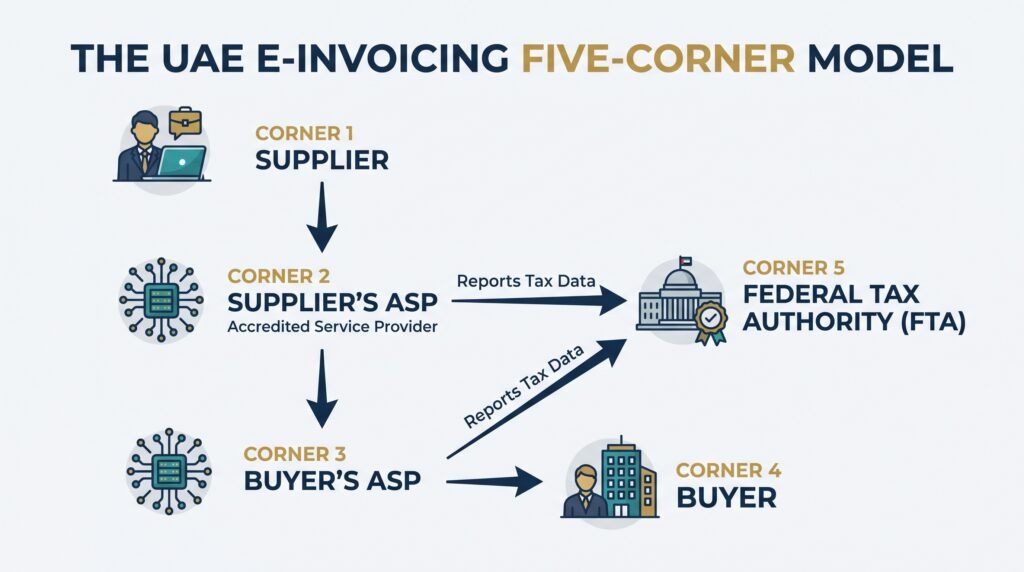
The system operates on a five-corner model:
Corner 1 (Supplier): Generates the transaction data in their accounting/ERP system.
Corner 2 (Supplier’s ASP): Validates, formats into compliant XML, sends tax data to the FTA, and transmits the invoice to the buyer’s provider.
Corner 3 (Buyer’s ASP): Receives the structured file, sends tax validation to the FTA, and delivers the data to the buyer.
Corner 4 (Buyer): Processes the invoice directly into their own ERP
Corner 5 (Federal Tax Authority): Receives real-time tax data directly from both ASPs.
Critical Implementation Timelines & Deadlines
The UAE government is rolling out the mandate in phases based on company size and turnover.
| Milestone / Entity Group | ASP Appointment Deadline | Mandatory Go-Live Date |
| Pilot & Voluntary Phase | Started 1 July 2026 | Voluntary (No penalties) |
| Large Enterprises (Annual revenue $\ge$ AED 50M) | 30 October 2026 | 1 January 2027 |
| Mid-Sized & Small Businesses (Annual revenue < AED 50M) | 31 March 2027 | 1 July 2027 |
| Government Entities | 31 March 2027 | 1 October 2027 |
Note: The Ministry of Finance extended the Accredited Service Provider (ASP) selection deadline for large enterprises to 30 October 2026, giving businesses extra time to select technical partners without shifting the final January 2027 live enforcement date.
Scope: Which Transactions and Entities Are Covered?
Scope under the e-invoicing framework is broader than standard VAT registration. Businesses operating in the UAE must assess their obligations based on transaction type, rather than assuming their VAT status exempts them.
Covered Transactions
B2B (Business-to-Business)
B2G (Business-to-Government)
G2B (Government-to-Business)
G2G (Government-to-Government)
Temporarily or Permanently Excluded
B2C Transactions: Consumer sales are currently outside the scope of this e-invoicing framework.
Intra-Group Transactions: Supplies between members of the same registered UAE VAT group have a 24-month grace period starting 1 January 2027.
Specific Exemptions: Sovereign government actions, international air passenger tickets, and certain qualifying exempt financial services.
Cost of Non-Compliance: Penalties Explained
Failing to comply with Cabinet Decision rules on electronic invoicing carries direct administrative fines:
Failure to implement or appoint an ASP on time: AED 5,000 per month.
Failure to issue/send an e-invoice or e-credit note on time: AED 100 per document (capped at AED 5,000 per month).
Failure to notify the FTA of system disruptions/malfunctions: AED 1,000 per day.
Failure to report master data changes to your ASP: AED 1,000 per day.
Action Plan: 6 Steps to Prepare Your Business
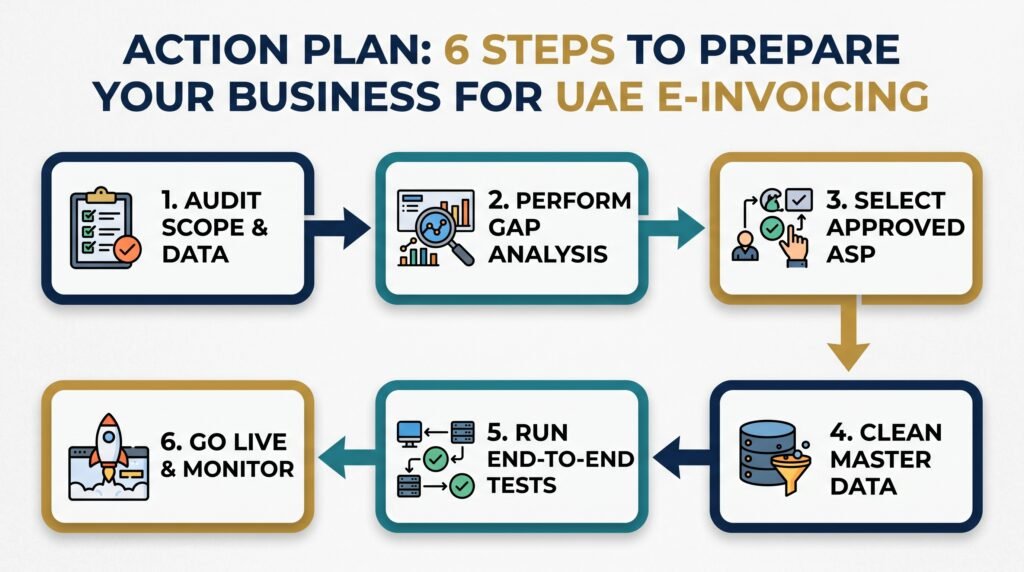
1. Audit your invoicing scenarios.
Work out all the document formats that your business produces such as Tax Invoices, Commercial Invoices, Credit Notes, and Debit Notes and determine the special billing situations like those involving free-zone trades, exports, continuous contracts, and transactions where an agent is responsible for billing.
2. Carry out an ERP readiness check.
Make sure that your current software (for example, TallyPrime, SAP, Oracle, or Zoho) is able to export the clean transaction fields required by the PINT-AE standards, such as the seller’s and buyer’s Tax Registration Numbers (TRNs), the line-item tax codes, the currencies, and the exact units of measurement.
3. Select an accredited service provider (ASP).
Each business that is within the scope must designate one accredited ASP to deal with the transmission of invoices and for FTA reporting. When assessing possible ASPs, you should consider how easy it is to integrate the system, the data security measures in place, and the cost on a per-transaction-volume basis. Onboarding takes place first on the FTA’s EmaraTax portal before a connection is made to your provider’s software.
4. Clean Master Data
The acceptance of customer addresses that are incomplete, TRNs that are invalid, or missing tax categories fails at the ASP level. It is important to carry out an audit and clean up your vendor and customer master data well before you begin testing.
5. Execute End-to-End Testing
Don’t check merely the invoice generation stage; instead, test the entire process, which includes sending the data to your ASP, receiving the validation, delivering it to the test buyer’s ASP, obtaining the tax reporting confirmations, and receiving the inbound vendor e-invoices directly into your ERP accounts payable module.
6. Review Retention Guidelines
Keep structured e-invoices and related digital data securely archived:
Standard Taxable Businesses: Minimum 5 years from the end of the tax period.
Real Estate Transactions: Minimum 15 years from the creation year.
Summary
The UAE e-invoicing system is a fundamental upgrade to how finance teams operate across the Emirates. By treating implementation as a core business transformation project rather than a last-minute IT fix, your company can ensure seamless compliance, eliminate administrative bottlenecks, and prevent costly operational penalties.
Frequently Asked Questions (FAQs)
1. Are PDF, Word, or scanned copy invoices considered valid e-invoices in the UAE?
No. The Federal Tax Authority (FTA) and Ministry of Finance (MoF) explicitly state that PDFs, Word documents, scanned paper copies, and static image files sent via email are not legal e-invoices. A compliant e-invoice must be issued, transmitted, and received as a structured XML document adhering to Peppol PINT-AE specifications.
2. Are Free Zone entities required to comply with UAE e-invoicing?
Yes. Free Zone entities are subject to the same e-invoicing requirements as mainland UAE businesses. Scope is determined by transaction type (B2B and B2G) and annual revenue thresholds, rather than geographic jurisdiction or tax-free status.
3. Do non-VAT registered businesses need to implement e-invoicing?
Yes, potentially. Under Ministerial Decision No. 243, the e-invoicing mandate applies to any person or business conducting covered B2B or B2G transactions in the UAE, regardless of whether they meet the threshold for standard VAT registration.
4. What are the administrative penalties for non-compliance?
Failure to adhere to the mandate carries non-discretionary fines under Cabinet Decision No. 106:
Failure to implement or appoint an Accredited Service Provider (ASP): AED 5,000 per month.
Failure to issue an e-invoice or e-credit note on time: AED 100 per document (capped at AED 5,000 per month).
Failure to report system disruptions or data changes: AED 1,000 per day.
(Note: Fines do not apply during voluntary testing before your mandatory go-live date.)
5. Does the UAE e-invoicing system replace regular VAT return filings?
No. E-invoicing automates how transaction data is reported and verified at the time of issuance. Standard VAT registration, quarterly VAT return filings, and tax payments remain required under existing UAE VAT law.